Tuesday, 31 July 2012

And There Was Cake For Breakfast

And there was cake for breakfast.

Scratch the skin of Kraków and she bleeds. Listen to Kraków's voice and she is both romantically melodic and hauntingly sad. Look into Kraków's face and she is beguilingly beautiful, generously welcoming, and yet etched with worry lines, eyes reddened by so many tears having been shed.

And there was cake for breakfast.

We had heard much of Kraków but had never before visited. Indeed, our proposed stay would be our first foray into Poland, a country which for us held intrigue and fascination but which also, we suspected, concealed a deeply troubled past.

And there was cake for breakfast.

The Piano Guest House was the perfect choice of where to stay in Kraków. A short walk from the Old Town and run by Madame Ola [a stage name for she is also a cabaret singer] and her two sons, it offers a taste of the real Poland with a quirkiness and a touch of bohemia guaranteed to make any visit a pleasurable experience and one not to be forgotten.
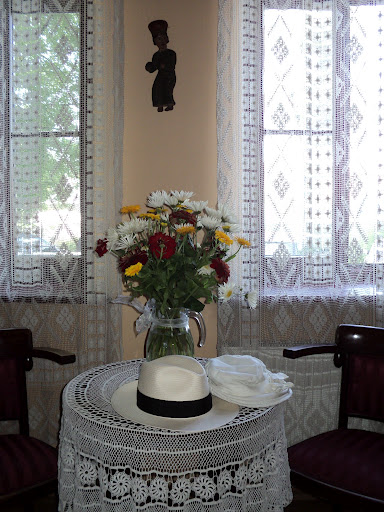
a glimpse into our bedroom at The Piano Guest House with hats at the ready for an outing

And there was cake for breakfast.

It could easily have been a scene at the Pensione Bertoloni taken from E.M. Forster's 'A Room with a View' when, upon arrival, Madame Ola swept us up and whisked us into the reception dining room for tea and cake. Mateusz, her son, on holiday from his work as a stage manager and conductor, produced a street map onto which places of interest, restaurants of distinction [he used to be a food critic], and hidden delights were marked with theatrical flamboyance and the confidence of a knowledgeable local.

And there was cake for breakfast.

Our five days were packed with interest, each one launched in glamorous style with the most glorious and delicious of breakfasts. Madame Ola, speaking only French and Russian [apart from her native Polish], draped from head to foot in black, floated among her guests offering black tea, green tea and coffee whilst the breakfast table was laden with all manner of culinary delights sprinkled with red currants which sparkled like rubies in the morning sun. Generous quantities of local hams, cheeses and sausage were supplemented with eggs, patés, yoghurts, cereals, tomatoes, cucumber, fruit and cake. 

the breakfast table without  cake - image from The Piano Guest House

Cake for breakfast! How decadent we thought, and how lovely.


P.S. For those who are intrigued to see and listen to Madame Ola, then we include a short video, of rather doubtful quality, found on 'Youtube':


Monday, 23 July 2012

Up at a Villa - to borrow from Robert Browning

the visitors' book of the Villa Massei on the occasion of the visit of HM Queen Sonja of Norway 
There is, as most will readily recognize, a fine but nonetheless distinct line to be drawn between a house in the country and a country house. The Villa Massei, the home of dear friends Gil Cohen and Paul Gervais de Bédée, falls without doubt into the latter category.

the drive approach to the Villa Massei as viewed from the balcony beyond the hall door

a corner of the entrance hall of the Villa Massei - the main door reflected in the looking glass

the fireplace of the principal drawing room at the Villa Massei as seen in summer

the bedroom as occupied by Jane and Lance Hattatt during their recent stay at the Villa Massei

Magnificently situated surrounded by its own olive groves and bosky woodlands, this Renaissance former hunting lodge is today set in the most splendid of formal gardens created over the past thirty or so years by its artistic and very talented owners, Gil and Paul.

the view from one of the many garden terraces towards the surrounding Tuscan hills

lemon trees in terracotta pots and grown in the local traditional manner side a gravel square

the rose pergola, constructed of handmade bricks, which forms a principal axis in the garden

the pool and fountain garden with two of four 'Alice in Wonderland' miniature chairs

And what joy it has been this past week to be entertained in true country house style to all the delights of the Villa Massei. For we have been treated to the most delicious of luncheons and dinners, to the enjoyment of the gardens and grounds in the coolness of the evening, to idling away time in the shade of the loggia, to the brilliance of the poolside and, should this have been not enough, to the meeting with friends on a Tuscan hillside for a salmon supper served 'alfresco' in the gloaming as well as to the delights of a tour of that most romantic of cities, Lucca, by horse drawn carriage.

evening shadows draw across the lawn - our bedroom windows white shuttered in the sun

contemplating the passing of time - Lance Hattatt seated in the shade of the Loggia

the swimming pool of the Villa Massei, the scene of a poolside luncheon with friends

the tree lined ramparts of Lucca which surround the city viewed from our horse drawn carriage

The day of our departure, following on so closely a Puccini concert in the Baptistery and Church of Santissimi Giovanni e Reparata the night before, found us by invitation at the grandiose Villa Reale. Once the property of Elisa Bonaparte Baciocchi, the grounds contain a green theatre dating from 1652, a Grotto of Pan, the near ruined Villa del Vescovo as well as water gardens, lemon parterre, and the most delightful, if somewhat startling, swimming pool complex of the 1920s now, alas, sadly neglected.

a detail on the splendid west front of the Cathedral Church of San Martino dating from 1204 

the portico front of the Villa Reale once the home of the regal Elisa Bonaparte Baciocchi

the now sadly near ruined Villa del Vescovo situated in the grounds of the Villa Reale

built in the 1920s, the swimming pool complex of the Villa Reale remains a fantasy of fun

The highlight of our time at the Villa Massei must be the private visit of HM Queen Sonja of Norway to luncheon and a personal tour of the gardens.

What excitement in the early morning as the Carabinieri descended in force to make their final check and then, some few hours later, to watch from the vantage point of the balcony overlooking the drive as the escort cars, lights flashing, wound their way up the twisting roads of the valley. And then, generously included by our hosts, Gil and Paul, to join with them to greet the Royal party, we descended to the entrance court.

entrance court of the Villa Massei where we assembled to greet HM Queen Sonja of Norway

Such fun it all was. For the Queen was knowledgeable, gracious and charming. Her 'faux' Ladies in Waiting, for the real ones had been imprisoned, so to speak, on the Royal Yacht, were equally delightful and so, in the manner of such an occasion, we progressed in Royal but relaxed fashion through each of the garden rooms.

the sixteenth century Grotto of the Villa Massei where pre luncheon drinks were served

a simple but inspirational table decoration in readiness for luncheon taken in the Loggia

Pre luncheon drinks served in the Grotto and then the most delicious buffet taken in the Loggia where the conversation, never stilted nor silent, was constantly punctuated with the sound of mirth and merriment.

a most regal chair, one of a pair, to be found in the drawing room of the Villa Massei

And now, our sojourn over, we are once more returned to Budapest but where the laughter, life and love of the Villa Massei continues to resound in our ears, as indeed it will do so for many, many years to come.

Thursday, 21 June 2012

Szabadság

the entrance hall of the Jókai Mór summer villa, Lake Balaton, Hungary

With the delightful prospect of the imminent arrival of friends from England, to be followed by planned trips to Krakow in Poland and Lucca in Italy, we find ourselves with such pleasurable demands on our time over the next few weeks that, as such, there will be little opportunity over for posting, responding to comments and, of course, visiting the many blogs which we so enjoy and which have become so much a part of our lives.

We trust that you will excuse our absence. We shall, however, much look forward to our return when we very much hope that you will be able to join us for our next post on Monday, 23rd. July. Until then, we send you all our warmest wishes. 

Monday, 18 June 2012

A Private Members' Club

We were to have met at 5pm. Our friend is a founder member of The Club and we had been invited to discuss joining its elite membership.

below the street sign a plaque commemorates the writer and dramatist, Sándor Bródy

We know the area well. The Jazz Club, Hungarian Radio and the Italian Institute are all within the immediate vicinity. The National Museum is there, on whose flights of steps the poet Petófi once famously declared the start of the War of Independence on 15th. March, 1848. The surrounding cobbled streets are home to a variety of gracious villas and palaces, dating back to the great nineteenth century building boom of Pest.

So where was Brody House?

only a very discreet sign to the right of the entrance door announces Brody House

There surely, we felt, could be no mistaking the street, named after the famous Hungarian writer and dramatist, Sándor Bródy. True, Budapest can hide its secrets well, of that we are fully aware, but, in this case an underground bunker would, in all likelihood, have been more visible.

At 5.45pm we abandoned all hope of our friendly assignation and headed for home. Of course, had we been equipped with Smartphones, Satellite Navigation Systems, or even a street number, we might not have had a wasted journey. But, perverse and foolish, oft we stray!

looking from the hall door of Brody House towards the fine, cantilevered staircase


the view back from the hall towards the street entrance - an example of C19 Pest architecture

It was therefore with a heightened sense of excitement that, two weeks later, we rearranged our Brody House meeting. This time, aided by a Google Map and the full address, there would be no mistake.

And so it was, feeling rather like Howard Carter on discovering the tomb of Tutankhamun, we pushed open the heavy street door and entered the secret world which is Brody House.

the main Reception Desk is situated on the second floor of Brody House - a steep climb


looking from the window of an upper floor into the inner courtyard so typical of Budapest

In a decorating style described by its owners and designers, William Clothier and Peter Grundberg, as 'rough luxe', peeling plaster is overhung with vast pieces of contemporary art, floorboards are bare, hi-tech sound systems sit alongside ancient 'Bush' radios, the antique, the modern, the glamorous and the commonplace are all combined with the skill of individuals who are clearly talented in the visual and creative arts and who give new meaning to 'shabby chic'.

a second floor drawing room where we sipped iced cucumber water on a hot summer's day

Established in 2009, Brody House has received rave reviews as 'the coolest place to stay in Budapest'. But it is so much more than somewhere to rest one's head at night. A bohemian members' club, it is a twenty-first century hub for showcasing the Arts. A packed social calendar provides a forum for 'open-minded, creative, inventive and socially curious' people to meet and to exchange ideas. And one can always book a room if the hour becomes late.


one of the guest bedrooms at Brody House - an example of 'rough luxe'

an 'unfitted' bathroom much loved by the English in their country houses 


Our friend is on the membership committee where the fate of prospective members is sealed. We have declared ourselves to be the only Hattatts in Britain, possibly Europe too, to be of sound mind, though some might doubt that, never to have been made bankrupt, and we do not eat peas with our knives. Will we next enter Brody House with membership cards?

Monday, 11 June 2012

No Such Thing as a Free Lunch

It is an unwritten but well observed rule that one is not invited to dinner at anyone's house in England for the food. Indeed, we can recall several dinner parties where the food was atrocious, burnt to a cinder, inedible or, quite simply, did not appear at all. But this matters not a jot, since on such occasions, what is offered to eat is far less important than how it is eaten and this, in turn, is far less significant than the conversation which accompanies each course.

Our own dinner party culinary calamities are legion. A spicy chicken main course, the name of which long escapes us, when Cayenne was mistakenly used in place of Paprika resulted in our guests attempting to put out the flames in their throats with copious quantities of wine. We have never known a merrier gathering. 


And whilst chewing with an open mouth, pointing at fellow diners with the flatware, and eating pudding [which in Britain should never be confused with dessert] with a spoon are all disasters of English dining etiquette, there is nothing more guaranteed to make our own dinner invitations cease to be issued than the inability to amuse, entertain or delight at the dinner table.

an amusing napkin, never a serviette, recently photographed at Brody House

Our friend, Anthony, is charm personified. Capable of elevating the dullest of tomato salads to food fit for the gods, his perfect manners, impeccable taste, witty conversation and sparkling humour ensure that his social calendar is never empty. And so too our American-Italian friends who, with glass of wine in one hand, canapé in the other, can 'work' a room with the professionalism of the captain of an ocean going liner navigating the smallest of harbours. Little wonder that the Marchesas, Princes and Princesses of Italian aristocracy vie with each other to entice them to the tables of their palazzos.

And whilst one will never go hungry in Hungary, since dining is given due deference, cooking is cherished, and eating is enjoyed by one and all, a hushed silence, rather than gales of laughter, is, alas, more likely to reign over the goose liver than not.


Jó étvágyat!

Tuesday, 5 June 2012

Double Dutch and Daisies

We had not expected our two Dutch friends to arrive with anything. It was enough, more than enough, that they should take time out from their busy lives and work to fly from Amsterdam to visit us here in Budapest over a long weekend just past.

detail of the daisy [translated into Dutch as 'madeliefje'] vase, a gift from our Dutch friends

But what excitement and joy when they appeared in the drawing room with two large, mysteriously shaped packages which, we were later to know, had been carefully nursed on laps throughout the flight to ensure a safe arrival.

First, an outer wrapping of pretty papers which, discarded, tantalising resulted in layer upon layer of protective 'bubble' wrap which, in turn, the last shreds eagerly torn away, revealed the most beautiful and thoughtfully chosen cups and saucers and, as though they were insufficient in themselves, a further gift of the most handsome and wonderful 'daisy' vase.

two exceedingly pretty 'Limoges' cups and saucers of a floral pattern
the 'daisy' vase catches the eye displayed on a corner of a bookcase in the Morning Room

The cups and saucers, of the finest porcelain, herald from Limoges and date from around the 1930s. Roses abound, set upon a grey coloured background upon which there is a further impression of flowers, the whole effect one of lightness and dancing movement. Held to the light the cups become translucent - a further delight. Too precious to be used we shall, on special occasions, as the days darken, in the manner of Jane Austen characters, sip hot chocolate from them on winter nights and think fondly of our friends, absent but present.

the 'Limoges' cups waiting on a table in the Drawing Room to be filled with hot chocolate!

And how well they know us. For the vase, perfect in every way for the Morning Room, is exactly our kind of thing. Manufactured in the town of Gouda in the mid-twentieth century by Plateelbakkerij Zuid-Holland [PZH] and marked 'Royal Zuid Holland', the pattern 'Sinia' is rare, making this very much a collectors' item. The trademark,  'little house', stamped on the base, depicts the Gate of Lazarus, the stone doorway of the old leper infirmary of 1609.

the maker's marks are clearly visible on the base of the Dutch daisy vase

Today, a wet morning, which matches our sadness at the departure of our friends, the vase's sunshine flowers, against an intense cobalt blue criss-crossed in gold, dispel any gloom and cheer away the clouds.

How fortunate are we.

Monday, 28 May 2012

Only Connect

a wall of pictures in our Budapest drawing room with 'Toft Church' shown bottom left 

Amongst our possessions is a ring made from the gun metal of a rifle, used during the Great War of 1914 - 1918, and passed down to us from grandparents. It is engraved simply 'YPRES'. A parent, as a young girl, received a prize at school from the Empress Eugenie, wife of Napoleon III, who at the time was in exile and living in Chislehurst, now a suburb of London. More recently, our very dear young Russian friends attended the sale, prior to refurbishment, of The Savoy Hotel and presented us with a set of flatware stamped 'Savoy'. Such are life's little connections which both intrigue and, where we are concerned, endlessly fascinate.

A couple of years ago we purchased a small, Victorian watercolour of a church. Signed 'Toft Church' and 'Painted by an invalid', it sparked our curiosity. During the nineteenth century it was not at all uncommon for paintings, usually the work of gifted amateurs, to be signed in such a way. But as to the whereabouts of this country church, set in its rather ragged churchyard, a little research revealed it to be St. Andrew's, Toft, Cambridgeshire.

the church of St. Andrew's, Toft, Cambridgeshire signed 'Painted by an invalid'

To date the painting took a little more time. However, it would appear that in 1890 the tower of St. Andrew's collapsed in its entirety, presumably on account of poor construction, not to be rebuilt until 1894. Judging from the ivy firmly established at the ruined end, and the somewhat makeshift temporary building attached, we assume that our watercolour may be dated, more or less accurately, to around 1893. Thus a  small, but significant, connection is made.

This Friday we look forward to a totally different kind of connection with the arrival from The Netherlands of our Dutch friends for a short stay here with us in Budapest. And on Saturday evening, around the dinner table, British, Dutch, Hungarians, Poles and Croats will, drawing on a diversity of experiences, connect countries and cultures in a manner which, despite all the current economic difficulties, underlines the strength of European unity.

P.S. Apologies to E.M. Forster for both using and reinterpreting his words in the title of this post.